The term with square) and the third term(i. e. the constant term). And their sum should be. Let's use the quadratic formula to solve for x:
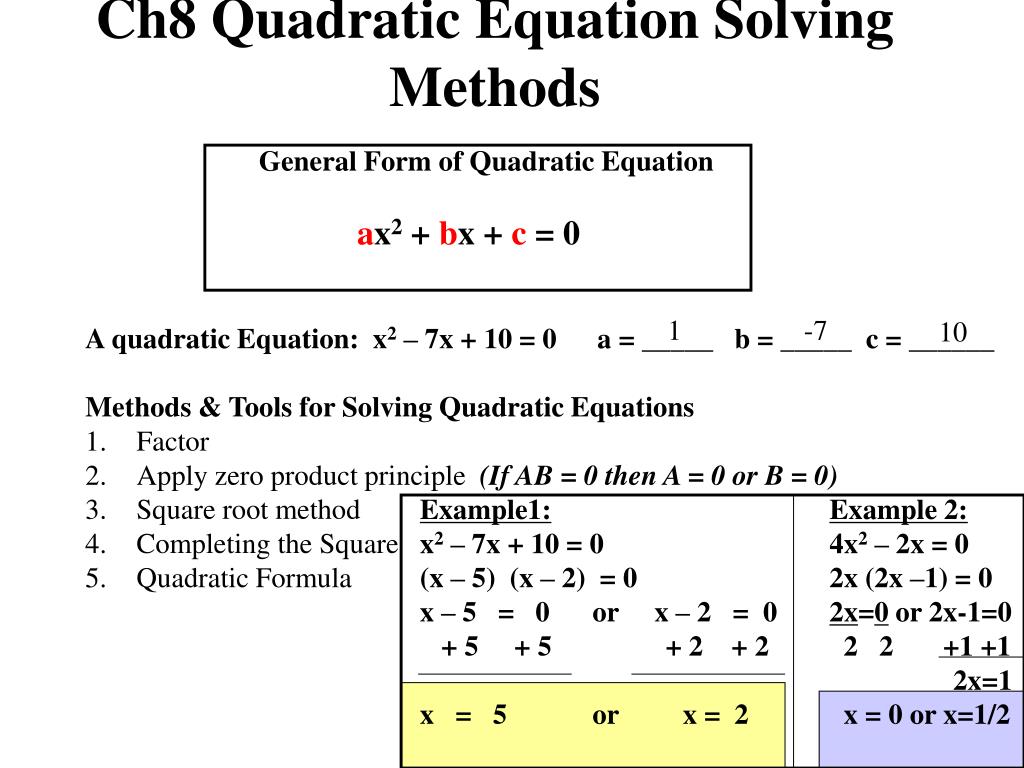
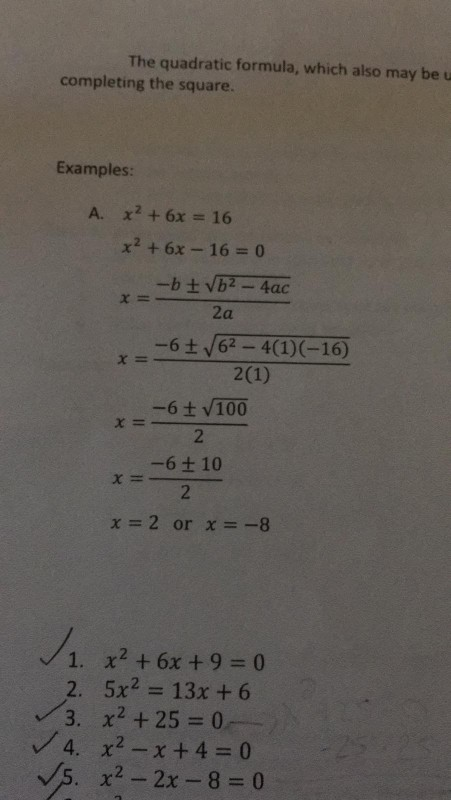
Starting with the general quadratic the general solution using the quadratic equation is: So lets solve ( notice , , and ) plug in a=1, b=7, and c=10 square 7 to get 49 multiply to get Hi, i need a bit of help on how to solve the following.
Move all the expressions to the left side of the equation. Tap for more steps. Subtract 7 x 7 x from both sides of the equation.
Add 10 10 to both sides of the equation. Start with the given equation. Factor the left side.
If you need me to go in depth about factoring, please let me know. Or set each factor equal to zero. Remember, if then either or.
Subtract from both sides. So our 1st answer is. Y = x^2 + 7x + 10 > 0 (1) first solve y = x^2 + 7x + 10 = 0 to get the 2 real roots.
Solve the inequality (1) by the algebraic method. X2 +7x + 10 = 0. We could right the equation in another form using brackets.
(x +2)(x + 5) = 0. In order to get two numbers to multiply and give 0, at least one number has to be 0. A stands for the first bracket and b for the second.
A x b = 0. A=0 or b=0 to make this equation valid. Click here👆to get an answer to your question ️ factorise:
X^2 + 7x + 10 = 0 Two numbers r and s sum up to 7 exactly when the average of the two numbers is \frac{1}{2}*7 = \frac{7}{2}. You can also see that the midpoint of r and s corresponds to the axis of symmetry of the parabola represented by the quadratic equation y=x^2+bx+c.
X2 + 7x + 10 = 0 x 2 + 7 x + 10 = 0. Factor x2 + 7x+10 x 2 + 7 x + 10 using the ac method. Tap for more steps.
Consider the form x 2 + b x + c x 2 + b x + c. Find a pair of integers whose product is c c and whose sum is b b. In this case, whose product is 10 10 and whose sum is 7 7.
2, 5 2, 5. Write the factored form using these integers. You can also see that the midpoint of r and s corresponds to the axis of symmetry of the parabola represented by the quadratic equation y=x^2+bx+c.